Abstract
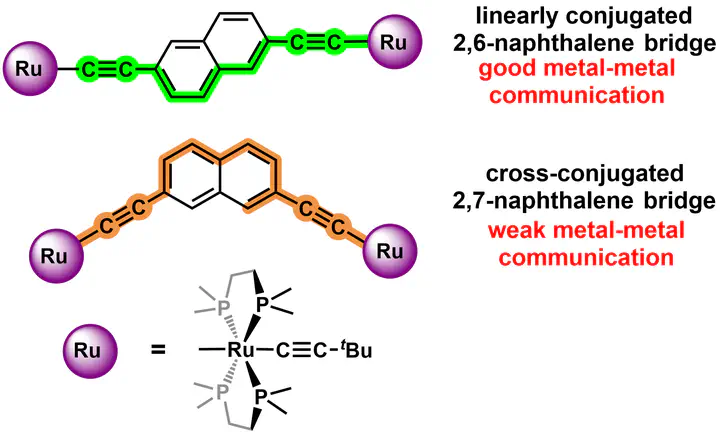
The electronic properties of a suite of di- and tri-nuclear ruthenium bis(acetylide)-based complexes incorporating phenylene and naphthylene bridges have been explored experimentally and computationally. The complexes, [trans-Ru(dmpe)2(C≡CtBu)2(μ-C≡C(2,6-C10H6)C≡C)], [trans-Ru(dmpe)2(C≡CtBu)2(μ-C≡C(2,7-C10H6)C≡C)], and [trans-Ru(dmpe)2(C≡CtBu)3(μ-(C≡C)3(1,3,5-C6H3)] were formed via the metathesis of terminal organic bisacetylenes with the methylruthenium complex, [trans-Ru(dmpe)2(CH3)(C≡CtBu)], in the presence of methanol and under mild conditions. Spectroelectrochemical analyses of these species showed that the linearly π-conjugated 2,6-naphthylene bridge enabled better electronic communication between redox-active ruthenium-acetylide sites than the cross-conjugated 2,7-naphthylene bridge.

Michelle Huang
Honours Student (2022)
Michelle is in her final year of completing a Bachelor of Advanced Science. Her Honours project focuses on the synthesis and properties of organometallic wires. Michelle works with the Peeks and Field groups.

Sebastian Devine-Poulos
Honours Student, joint with Field group (2025)

Martin Peeks
Scientia Associate Professor
I am interested in understanding the fundamental chemistry of complex molecules and molecular systems.