Carbonyl Derivatization Tunes Triplet-State Aromaticity and Dynamics in Fused-Ring Cyclic Amides
Abstract
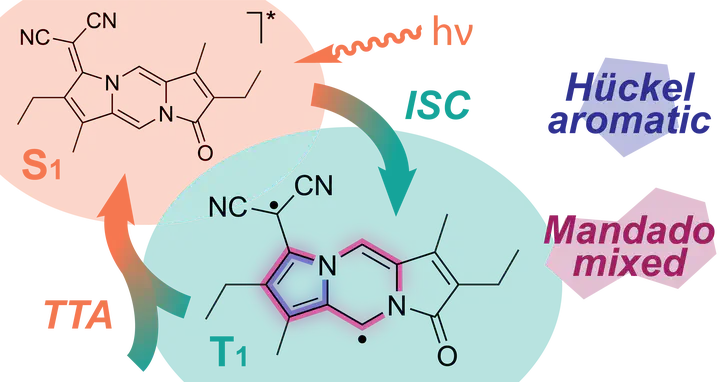
Singlet fission (SF) and triplet-triplet annihilation upconversion (TTA-UC) are photophysical processes which, respectively, result in the division of one high energy singlet state into two lower-energy triplet states, and vice versa. These processes are components of strategies to overcome the efficiency limits of photovoltaic devices, by funneling more energy into silicon solar cells. Molecules featuring a fused π-conjugated ring system interrupted by amide groups have recently attracted interest for singlet fission owing to their greater stability than acene-based chromophores. While aromaticity has been regularly used to design chromophores for both SF and TTA-UC and rationalize results, debate continues about the relevance and application of the concept. Here, we describe the spectroscopic properties of novel derivatives of a 5-6-5 fused-ring chromophore with a central 8π 1,4-diacyl-1,4-dihydropyrazine ring. Density functional theory calculations suggest that the parent chromophore does not meet the key thermodynamic criterion for SF, i.e. E(S1) ≥ 2E(T1), but that modifying the carbonyl groups via microwave-assisted thionation and subsequent silver(I)-promoted condensation will substantially modulate the E(T1)/E(S1) ratio. Through photophysical measurements including time-resolved absorption and magneto-photoluminescence, we demonstrate that intersystem crossing followed by triplet-triplet annihilation occurs upon excitation of a dicyanomethylene-substituted derivative. We propose an explanation for these observations in terms of Mandado’s (2n + 1) aromaticity rule, which provides guidance for future designs of multiexcitonic chromophore systems based on the cyclic amide motif.

Martin Peeks
Scientia Associate Professor
I am interested in understanding the fundamental chemistry of complex molecules and molecular systems.