Efficient Removal of Short-Chain Perfluoroalkyl Substances by Cavity-Directed Aggregation in a Molecular Cage Host
Abstract
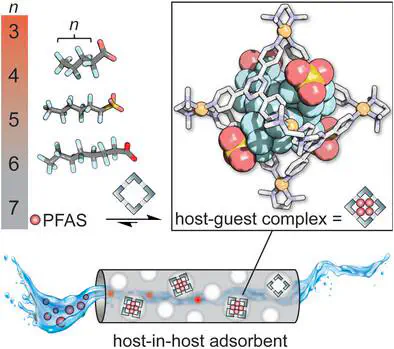
The removal of perfluoroalkyl substances (PFAS) from water is critical to protect human health and the environment. However, removing short-chain PFAS remains a significant challenge, and a molecular-level understanding of their binding is lacking. Here, we utilise a metal-organic cage (MOC 1) as a model “pore” to elucidate the host-guest chemistry of short- and long-chain PFAS in water. X-ray crystallography of six 1·(PFAS)n complexes reveals a broad range of PFAS are encapsulated as anionic aggregates, with the degree of guest-guest aggregation decreasing as the fluoroalkyl chain length increases. 1H and 19F NMR spectroscopy, together with isothermal titration calorimetry reveal the cage host displays unusually large, entropy-driven association constants in water (log K ≥ 5) which remain high for short-chain PFAS. Doping mesoporous silica 60A with only ∼1 wt% of the cage results in a host-in-host adsorbent that removes >98% of short- and long-chain PFAS at environmentally relevant concentrations under flow-through conditions. The adsorbent exhibits rapid PFAS uptake with high selectivity over common water-borne anions and full regenerability. These findings translate host-guest chemistry into an effective materials platform for PFAS remediation, including short-chain species that evade conventional removal methods.

Martin Peeks
Scientia Associate Professor
I am interested in understanding the fundamental chemistry of complex molecules and molecular systems.